
Minimal Pairs in Action: Helping Children Overcome Speech Sound Errors
October 1, 2024
Table of Contents
Find minimal pairs examples and FREE downloadable minimal pairs pdf worksheets here!

Speech development is a complex journey for children, and sometimes they need a little extra help along the way. Speech-Language Pathologists (SLPs) have a variety of tools at their disposal to assist children in overcoming speech sound disorders.
One particularly effective technique is the use of minimal pairs in speech therapy. In this blog post, we’ll explore when and why SLPs use minimal pairs, provide minimal pairs examples, and delve into specific cases like minimal pairs for final consonant deletion, minimal pairs for /s/ vs. /ʃ/ (/s/ vs. “sh”), minimal pairs for /θ/ vs. /f/ (voiceless “th” vs. /f/), minimal pairs for /ʃ/ vs. /ʧ/ (“sh” vs. “ch)” minimal pairs for fronting, and minimal pairs for /f/ and /v/.
What Are Minimal Pairs?
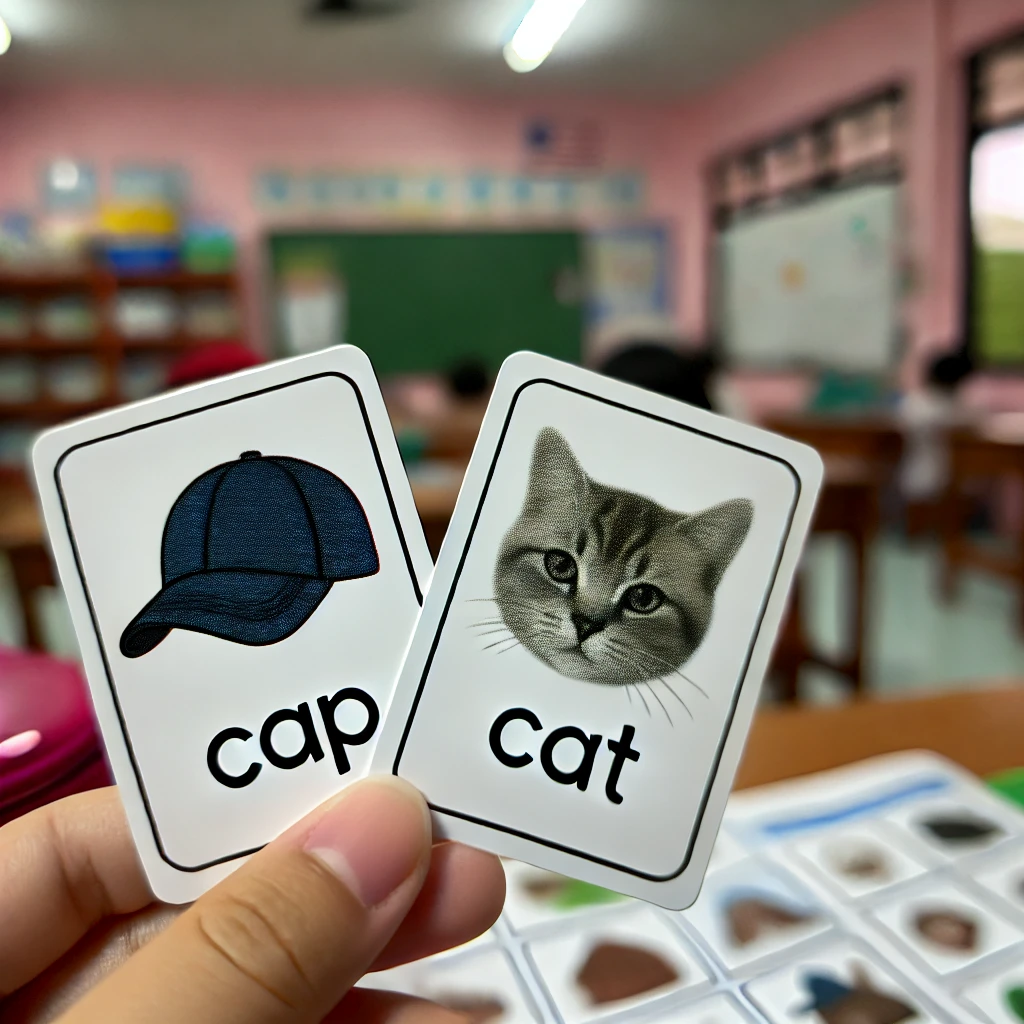
Minimal pairs are pairs of words that differ by only a single sound, known as a phoneme. Speech-Language Pathologists (SLPs) frequently use minimal pairs therapy to emphasize sound contrasts when addressing phonological processes. Minimal pairs examples include:
- “Cat” and “Cap”
- “Ship” and “Sheep”
- “Thumb” and “Sum”
These pairs are crucial because the one sound difference changes the meaning of the word entirely. This makes them an excellent tool for highlighting specific speech sound errors in therapy.
Why Use Minimal Pairs in Speech Therapy?
The primary goal of minimal pairs speech therapy is to treat persistent phonological processes by helping children recognize and produce the distinct sounds that they may be substituting with a different sound. By contrasting words that are nearly identical except for one phoneme, children become more aware of the importance of that sound in conveying meaning.
When Do SLPs Use Minimal Pairs?
SLPs typically use minimal pairs when a child consistently substitutes one sound for another or omits sounds altogether. This approach is particularly effective for addressing phonological processes.
What Are Phonological Processes?
Phonological processes are patterns that young children use to simplify speech sounds as they learn to talk. These processes are a normal part of language development but may become a concern if they persist beyond certain ages. Examples of common phonological processes include final consonant deletion (leaving off the last sound of a word), fronting (substituting sounds made in the back of the mouth with sounds from the front), and cluster reduction (simplifying a consonant blend). Addressing these processes early is crucial for effective communication, especially as children reach school age.
How Do SLPs Use Minimal Pairs in Speech Therapy?
Here’s a helpful sequence for using minimal pairs in speech therapy:
Familiarization: Begin by introducing each picture card to make sure the child understands the meaning of each target word (e,g., “here is a ‘wreath,’ like a Christmas wreath that you can hang on your door; here is a ‘reef,’ fish and other sea animals live in reefs in the ocean. What is a wreath? (pointing to picture card), “What is a reef?” (pointing to picture card)).
Auditory Discrimination: Place one pair of cards at a time in front of the child. Say each target word and ask the child to point to the word they heard. For example, “Point to the wreath.” The child chooses the correct card. “Good! Point to ‘reef'”. The child chooses the correct card again. “Good job! Point to the reef.” The child chooses incorrectly “Oh! Nice try! That was ‘reef.'” (Therapist points to correct card).
Alternatively, spread out individual minimal pair cards, say a target word, and have the child pick the correct card. Repeat this until the child accurately picks each card.
Production: Have the child practice saying the minimal pair target words. You can even encourage the child to take on the “teacher” role, where they instruct the SLP or parent on which word to pick. Pick the card that matches the child’s pronunciation, even if it doesn’t match their intended word. If there’s a mistake (e.g., the child says, “No, I said pug!”), pick up both cards and ask which word they meant.
Auditory Bombardment: Read a list of words with the target sound or sound pattern to boost the child’s awareness. Using headphones and slight amplification can enhance this step for improved focus.
Minimal Pairs Examples and Their Applications
Let’s explore some common speech sound errors and how minimal pairs can help correct them.
Minimal Pairs for Final Consonant Deletion
Final consonant deletion (FCD) is when a child omits the consonant sound at the end of words. For example, saying “ca” instead of “cat.” The typical age of elimination for FCD is 3 years.
More Examples:
- “Bow” vs. “Boat”
- “See” vs. “Seat”
Application:
FCD often involves the omission of the following sounds at the end of a word:
- Plosives /p/, /b/, /t/, /d/, /k/
- Fricatives /s’/, /z/, /f/, /v/
- Nasals /m/, /n/
Minimal Pairs for /s/ vs. /ʃ/ (Minimal Pairs for /s/ vs. “sh”)
Children may substitute the /s/ sound for the “sh” sound, which indicates the phonological process known as fronting. The typical age of elimination for fronting is 3.5 years.

Examples:
- “Sip” vs. “Ship”
- “Seal” vs. “Sheel”
Application:
Fronting is the replacement of a velar or palatal sound with an alveolar sound. With minimal pairs therapy, children learn to differentiate between the alveolar fricative /s/ and the palatal fricative “sh,” improving their intelligibility.
Minimal Pairs for /θ/ vs. /f/ (Minimal Pairs for voiceless “th” vs. /f/)
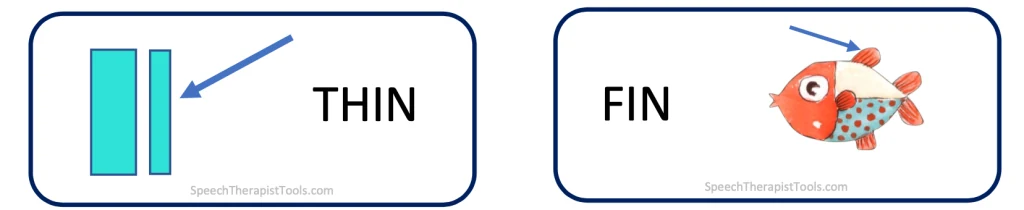
The voiceless “th” sound can be very challenging and is commonly substituted with /f/. Voiceless “th” is one of the last sounds to be mastered in typical development, usually around 7-8 years of age.
Examples:
- “Thin” vs. “Fin”
- “Three” vs. “Free”
Application:
The voiceless “th” is a challenging sound due to its unique placement. Minimal pairs therapy help children practice the interdental placement for “th”, distinguishing it from the labiodental placement of /f/.
Minimal Pairs for /ʃ/ vs. /ʧ/ (Minimal Pairs for “sh” vs. “ch”)
Confusion between “sh” and “ch” sounds is common, and indicates the phonological process known as deaffrication.

Examples:
- “Sheep” vs. “Cheap”
- “Share” vs. “Chair”
Application:
Using minimal pairs for “sh” vs. “ch”, children can practice the continuous “sh” sound versus the affricate “ch” sound, refining their articulation skills.
Minimal Pairs for Fronting
Fronting occurs when a child replaces sounds made at the back of the mouth with those made at the front.

Examples:
- “Key” vs. “Tea”
- “Go” vs. “Doe”
Application:
Minimal pairs for fronting help the child practice back-of-the-mouth sounds, reducing the tendency to substitute them with front-of-the-mouth sounds.
Minimal Pairs for /f/ and /v/
Substituting /f/ for /v/ (or vice versa) is another common issue.

Examples:
- “Fan” vs. “Van”
- “Fine” vs. “Vine”
Application:
Practicing minimal pairs f and v helps the child distinguish between the voiceless /f/ and the voiced /v/, enhancing their speech clarity.
Minimal Pairs in Action: Conclusion
Minimal pairs are a powerful and effective tool in speech therapy. They help children become aware of the subtle differences in sounds that can change word meanings, motivating them to adjust their speech accordingly. Whether addressing final consonant deletion, fronting or /s/ vs. “sh“, “th” vs. /f/, “sh” vs. “ch,” or /f/ and /v/ substitutions, minimal pairs offer a targeted approach to improving articulation and phonological skills. If your child is struggling with specific speech sounds, consider consulting an SLP who can utilize minimal pairs speech therapy to support their communication development.
Remember, early intervention can make a significant difference in a child’s speech and language outcomes. By focusing on these minimal pairs examples, SLPs provide children with the tools they need to communicate effectively and confidently.