
Play & Grow by SpeechTherapistTools.com
Play & Grow by SpeechTherapistTools.com
“Play & Grow” is a FREE resource by SpeechTherapistTools.com designed to complement educational frameworks such as play-based learning and the Montessori approach. Simply enter a toy and the child’s age, and the app will quickly provide multiple developmentally-based suggestions on how to use the toy to maximize learning potential.
“Play & Grow”: Enhance Play-Based & Montessori Learning
“Play & Grow” is a FREE resource by SpeechTherapistTools.com designed to complement educational frameworks such as play-based learning and the Montessori approach. Simply enter a toy and the child’s age, and the app will quickly provide multiple developmentally-based suggestions on how to use the toy to maximize learning potential.
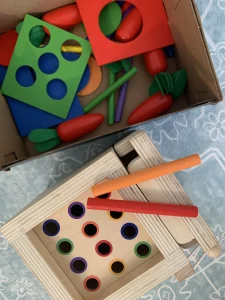
The Object Permanence Box is a classic Montessori toy which fosters play-based learning, encouraging curiosity, problem-solving, and hands-on exploration—perfect for little minds developing essential cognitive skills!
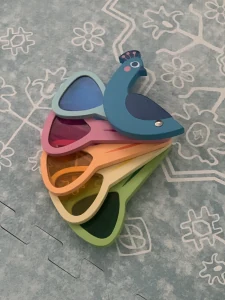
This Montessori-inspired peacock color toy is perfect for helping little hands develop fine motor skills, color recognition, and creativity.
What is Play-Based Learning?
Play-based learning is an educational approach where children learn through play rather than direct instruction. It is a child-centered method that encourages exploration, creativity, problem-solving, and social interaction. Although play-based learning is commonly used in early childhood education, it can be applied across various age groups.
Key Elements of Play-Based Learning
- Child-Led Exploration – Children choose activities that interest them, fostering engagement and intrinsic motivation.
- Hands-On Experiences – Learning happens through doing, such as building blocks, role-playing, or experimenting with materials.
- Social Interaction – Encourages collaboration, negotiation, and communication among peers.
- Imaginative Play – Activities like pretend play or storytelling help develop creativity and critical thinking.
- Open-Ended Activities – Instead of following strict rules, children explore concepts in a flexible way.
Examples of Play-Based Learning Activities
- Dramatic Play (e.g., playing house, pretending to be a doctor)
- Building & Construction (e.g., using LEGO, wooden blocks)
- Sensory Play (e.g., playing with sand, water, or playdough)
- Outdoor Play (e.g., running, climbing, exploring nature)
- Board Games & Puzzles (e.g., problem-solving activities that require strategic thinking)
Play-based learning is widely recognized in educational frameworks such as Montessori, Reggio Emilia, and Waldorf approaches, as it supports holistic development and prepares children for future learning in a natural, engaging way.
What is the Montessori Method?
The Montessori Method is an educational approach developed by Dr. Maria Montessori in the early 1900s. It emphasizes child-led, hands-on learning in a structured environment that promotes independence, critical thinking, and self-discipline.
Key Principles of the Montessori Method
Child-Centered Learning
- Children learn at their own pace, choosing activities based on their interests.
- The teacher acts as a guide rather than a lecturer.
Hands-On, Experiential Learning
- Montessori classrooms use specialized materials (e.g., sandpaper letters, bead chains) that encourage tactile learning.
- Learning is concrete before abstract, meaning children manipulate objects before grasping abstract concepts.
Prepared Environment
- The classroom is designed for independence, with child-sized furniture and easily accessible materials.
- Everything is organized and intentional, fostering focus and responsibility.
Independence & Self-Discipline
- Children are encouraged to self-direct their learning, developing confidence and responsibility.
- There is a focus on practical life skills (e.g., dressing, cleaning, food preparation).
Mixed-Age Classrooms
- Children of different ages (typically 3-year age spans) learn together.
- Older children mentor younger ones, fostering leadership and collaboration.
Intrinsic Motivation
- Montessori avoids external rewards or punishments, emphasizing the joy of learning.
- Children develop a sense of self-motivation and curiosity.
The Montessori Method is widely used in early childhood education but also extends to elementary and secondary levels. It is a highly respected approach that nurtures lifelong curiosity, problem-solving skills, and a love for learning.
How Does “Play & Grow” Support Play-Based & Montessori Learning?
“Play & Grow” aligns with play-based learning and the Montessori method by encouraging hands-on exploration, creativity, and problem-solving. Instead of relying on structured lessons, children learn through open-ended or structured play, fostering critical thinking, language development, and motor skills.
By tailoring play experiences to a child’s developmental stage, “Play & Grow” ensures that playtime remains both engaging and educational, making it a valuable tool for parents, teachers, and speech therapists looking to support early learning in a fun and interactive way.